Sunday, September 7, 2008
Peking Acrobats!
I know this is a little off topic, but I just saw them perform with the Los Angeles Philharmonic, and it was absolutely amazing! This was just one of their performances for the night. Other acts included contortionism all over the place, spinning plates, chair balancing, balancing on each other's heads, jumping through hoops, lion dancing, martial arts and the list goes on and on. The most nerve-wracking act was this one where this amazing woman did a one-handed horizontal flagging of her body on top of a stack of chairs as tall as the stage of the Hollywood Bowl. The four legs of the bottom chair stood on top of four empty glass bottles, which were on top of a platform about 6 feet high. It was quality entertainment.
The conductor of the Philharmonic was great as well. He was enthusiastic and entertaining, and the musical selection for the evening was superb.
I thought about relating this post to health somehow - like, it takes lots of qi and blood to be able to perform the way they do; or being in the open air and enjoying live music builds qi; etc, etc. But then it just takes away from the fact that these people are SUPERHUMAN and deserve their own post.
If you ever get the chance to see them, give me a call so I can go with you!

Saturday, September 6, 2008
How Much Sugar Should I Eat?

The short answer is: just a little.
The long answer? Well, you could turn to this misleading website by the Corn Refiner's Association for some incomplete answers on the "benefits" of high fructose corn syrup (thanks to Jason Moskovitz for the link). For instance, in the Q&A section, there's this helpful information...
Why do we crave sweetness?
People have evolved from the hunter-gatherers when sweetness indicated that a food was safe to eat. Sweetness was and still is a key taste marker to survival and good health. Sugars as carbohydrates are an important supply of energy to the body. This energy was essential to our survival in our not-so-distant, hunter-gatherer past. However, over the last 12,000 years our way of life has changed significantly. In contrast to our past, an abundance of calories is not essential, but the craving for sweet things remains.
If you can get past the appalling grammar, you may notice the stunted logic and historical inaccuracies. The one sentence that I agree with states that life has changed significantly over the past 12,000 years. We do still have hunter-gatherer instincts. But if you're hunting the aisles of a typical American supermarket for sustenance, sweetness is not a "key taste marker to survival". In fact, avoiding sweetness in this context will help you avoid many of the major "diseases of affluence" (those caused by too much of something rather than too little) such as diabetes.
This site is obviously designed to put you at ease as you wash down your Lil Debbie snack cakes with Dr. Pepper, but regular sugar is not so great either. I went through a phase where I wouldn't drink sodas made with corn syrup, only those made with real sugar. For some reason I thought I was being healthy - and then I realized that I was drinking way more soda than I usually did.
The corn syrup site also bad mouths supposedly natural sweeteners such as concentrated white grape juice. I have to admit that I was taken in by this sweetener at first, particularly in jam and jelly. I found this brand that was sweetened with fruit juice, and I thought "great! natural!". Again, it's what they leave out that gets you. The fruit juice they use is concentrated to such a degree that it's not much better than regular sugar.
The existence of this site is a testament to the popularity of books like Eric Schlosser's Fast Food Nation and Greg Critser's Fat Land: How Americans Became the Fattest People in the World. (The latter book is where I learned about Earl Butz, pictured above. He was Nixon's agriculture secretary and was chiefly responsible for the increase in corn subsidies to ridiculous levels, which in turn ensured the huge surplus of corn that led to the synthesizing of high fructose corn syrup and its subsequent injection into nearly every single packaged item on your supermarket shelf.) Just be aware that the Corn Refiners Association has millions and millions of dollars invested in getting you to eat more crap.
So, where should you get your sugars? Here's an idea: from whole food (which you can get at many places besides the overpriced Whole Foods Market). If you crave something sweet, try eating a piece of fruit. I remember when I was growing up there was always a fruit bowl around. Keep some fruit around all the time and you'll always have sweetness. Another thing you can do is chew your whole-grain rice more completely. Sugars are simple carbohydrates. When you chew your rice or sweet potato or whatever you prefer, salivary amylase breaks down starch into sugar. If you chew incompletely, you don't get the benefit of the full digestive process.
Sweetness is important. In Chinese medicine, the sweet flavor is associated with the earth phase, which in turn relates to the spleen, pancreas, stomach, and the colors yellow and orange. A nice piece of fruit for dessert lifts the digestive energy, or spleen qi.
So don't run from sweetness - run from added sugars both natural and artificial! Most of you have no need of them. By habit many of us are used to eating much more sugar than we need. If you can break the habit, you'll be much healthier!
Friday, September 5, 2008
Chinese Medicine Pharmacy

Take a look at this gorgeous Chinese medicine pharmacy. I don't know where this picture came from, but it's a nice example of a beautiful herbal pharmacy. A friend of mine went to China earlier this year and saw many pharmacies just like this.
If you're unfamiliar with Chinese herbal pharmacies, it's worth a trip to your local Chinatown to see one in action. You probably won't see one as nice as the one in this picture, but the idea is the same. You walk in with your prescription from your herbalist and hand it to someone behind the counter. They'll price it for you and, once you give the okay, will start assembling the formula.
A typical Chinese herbal prescription contains anywhere from 4-18 different ingredients. Each one has to be weighed and measured out - this all takes place on the counter in front of you, so you can see what's going on. If you want to get all Chinese about it, you can criticize the herbal pharmacists as they go about their job, telling them to give you the high-grade herbs or asking if they're sure they weighed everything correctly. Of course, this has to be done in Chinese, preferably in the dialect that the herbalists are familiar with.
Thursday, September 4, 2008
Ben Cao Gang Mu
Do you know who Li Shi Zhen is? Well, you should. He's pretty awesome. During the Ming Dynasty, he compiled the book known as the Ben Cao Gang Mu 本草纲目, or the "Grand Materia Medica." He spent all of his life studying herbs, 27 years of which was spent writing this one book. It has 1,892 individual herbs listed, 374 of which were not previously listed in any other herbal manual. He also went through all other available texts for comparison and corrected errors he found. He is basically the biggest herb nerd in the history of the world... and my idol.
(Sun Si Miao is still the love of my life though... sorry, Li Shi Zhen)
The Ben Cao Gang Mu has an expansive variety of herbs listed, far more than any other herbal book in English or Chinese. Lucky for us, as of 2004, you can get the very first complete English translation of the Ben Cao Gang Mu in a six-volume set. I want it.
By the way, the video is of Jay Chou, that guy from that movie Curse of the Golden Flower. He's a big-time pop star in Taiwan and China, and he's singing his song called Ben Cao Gang Mu. Read the lyrics! I got a good chuckle out of it.

Wednesday, September 3, 2008
Broken Shelves

Earlier today, a 19-square-mile piece of ice in the Arctic broke free and floated out to sea like a giant, Manhattan-sized ship. It had been a part of Ellesmere Island, Canada for the last three to four thousand years.
That's a really big piece of ice, right? Every summer, the Arctic cap tends to lose some of its shelf, but usually regains it back over the colder months. According to today's article, the losses for this summer have equaled 82-square-miles.
These changes are irreversible under the present climate and indicate that the environmental conditions that have kept these ice shelves in balance for thousands of years are no longer presentFor clarification, ice shelves are floating pieces of ice that are attached to land, but sit over the water. The good news for us is that sea level does not change when floating ice melts. But the breakup of an ice shelf leaves a glacier (ice over land) exposed and more susceptible to cracks and breaks. When a glacier melts, sea level rises. Melting glaciers also induce the breaking-off of shelf ice, further inducing glacial surges that can drastically change sea level.
Basically, this is not a good thing. Well, not for the ecosystems that live on the shelves, which will no longer exist by 2049 according to UCAR, and not for us or any other species that likes to live on land, and without being baked alive.
The planet, however, will be just fine and the creatures of the sea will start to take over again. Maybe the octopuses will become the next super species, and have pet sharks, and farm schools of guppies, and trade crabs as currency.
Or maybe it will be just like that Kevin Costner movie, and we'll all start to develop gills behind our ears and dirt will become a delicacy. Mmmmmm, delicious!

Tuesday, September 2, 2008
The Fire Shower
After a cold day on the tundra, there's nothing I like better than a warm, refreshing fire shower.
I've never seen this done before, but it's obviously another part of the acupuncturist's toolkit, things that can be done besides sticking needles into the body. We've already had a post about gua sha. In the future we'll cover moxa, cupping, and all the various scraping and tapping tools that acupuncturists use to access the body's meridian system. EFT is an example of a more modern tool which accesses the meridian system.
Monday, September 1, 2008
Fruits!

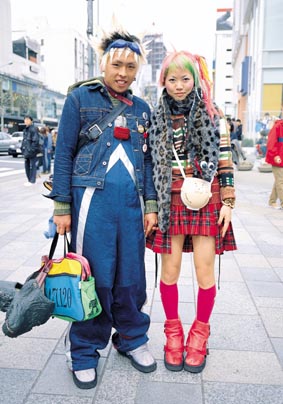
Check out this super awesome short film on fruits! (Not the fashion-minded Japanese youth, but the delicious kind that you can eat.) I wasn't able to embed the video clip, but if you click on the link, I promise you won't be disappointed. Towards the end you'll see images of Sang Shen 桑椹 mulberry fruit and Fo Shou 佛手 Buddha's hand citron, two fruits used in Chinese medicine.
You can read about the above picture here, or read about other things going on in the world of plants at The Botanical Society of America.
Subscribe to:
Posts (Atom)